
Nima Adventure Trek & Expedition P. Ltd.
Boudha-06, Kathmandu, Nepal
+977-9851114058 · info@nimaadventure.com
Boudha-06, Kathmandu, Nepal
+977-9851114058 · info@nimaadventure.com
Climb the world's fourth-highest mountain via the Khumbu Icefall, Lhotse Face and Lhotse Couloir, with a one-to-one climbing Sherpa and a helicopter return to Lukla.
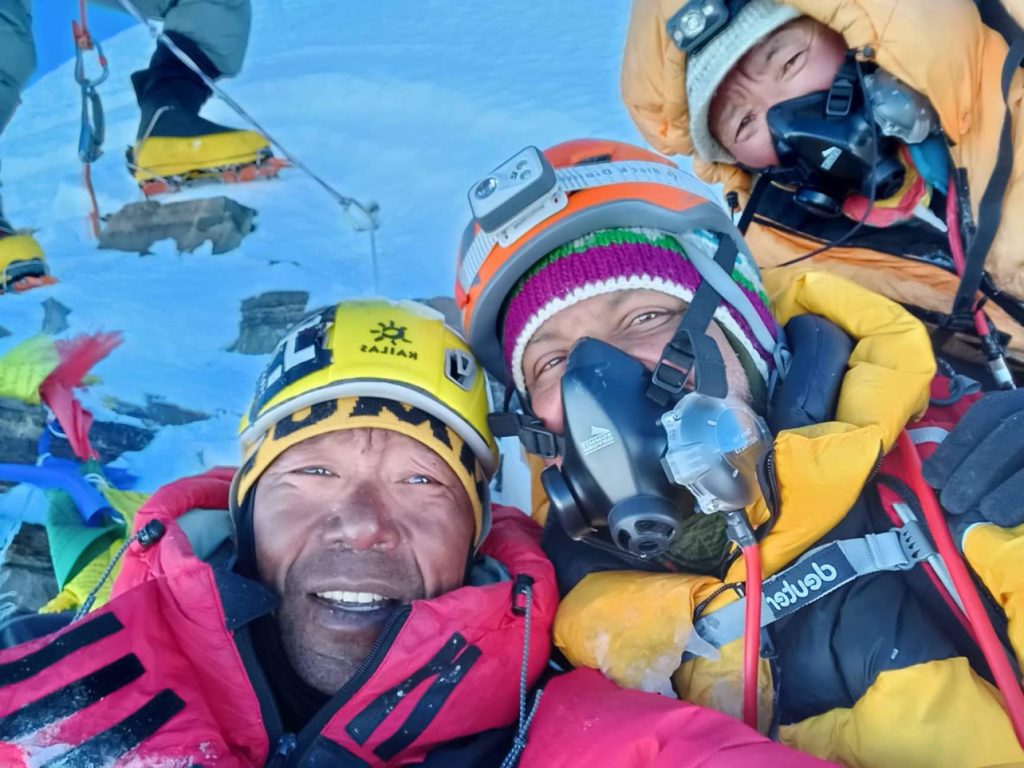
Lhotse, at 8,516 m, is the fourth-highest mountain in the world and Everest's immediate southern neighbour, linked to it by the South Col. Its name means "south peak" in Tibetan. For much of the way, Lhotse climbers share the Everest route, but high on the Lhotse Face the paths divide: while Everest teams traverse to the South Col, Lhotse climbers continue to their own high camp and into the narrow, rocky Lhotse Couloir that leads to the summit. It is a demanding climb with a dramatic finish and far fewer people on summit day than on Everest.
Our 62-day expedition starts with the flight to Lukla and the classic trek up the Khumbu valley through Namche Bazaar, Tengboche, Dingboche and Lobuche, with acclimatisation days at Namche and Lobuche and a night at Gorak Shep before reaching Base Camp at around 5,364 m. A long climbing period of more than six weeks then allows for patient rotations through the Khumbu Icefall to Camp I and Camp II in the Western Cwm and up the steep ice of the Lhotse Face to Camp III, followed by a summit push in the best available weather window.
Each member climbs with a personal, government-licensed climbing Sherpa on a one-to-one basis. Supplementary oxygen with a modern mask and regulator, fixed and main ropes, high-camp tents, food and fuel, daily weather forecasts and medical consultation at the Himalayan Rescue Association clinic at Base Camp are all included. At Base Camp you have your own tent, a heated dining tent and generator power for charging. When the climb is over, a helicopter transfer from Base Camp to Lukla saves several days of walking and gets you back to Kathmandu rested and on schedule.
Lhotse suits experienced high-altitude mountaineers who have climbed at least one 7,000 m peak, and preferably an 8,000 m peak, and who are confident on steep ice and fixed ropes. The couloir is steep, narrow and often icy or rocky near the top, so solid crampon technique and calm movement on exposed ground are essential. It is also a popular choice for climbers who have already summited Everest, or who want to experience the Khumbu's great amphitheatre away from the Everest crowds.
Nima Adventure is a Kathmandu-based operator led by Managing Director Kanchha Sherpa, a career Himalayan guide. We handle the climbing permit, liaison officer, national park and icefall fees, plan the logistics carefully and keep you informed at every stage, so that you can focus on climbing well.
On arrival at Tribhuvan International Airport, a Nima Adventure representative meets you and transfers you to your 4-star hotel. The rest of the day is free to recover from the journey. If you have the energy, take an easy stroll around Thamel or visit the Boudhanath Stupa, a short distance from our office in Boudha. In the evening we review your documents and insurance details and run through the programme for the coming days.
Your climbing Sherpa checks your personal equipment, from boots and crampons to down suit and sleeping bag, so that any gaps can be filled in Kathmandu's mountaineering shops. We complete the permit formalities, meet the government liaison officer and attend the official expedition briefing at the Department of Tourism. The afternoon is for packing the expedition bags that travel by porter and yak to Base Camp, followed by a final evening of city comforts.
An early morning flight brings you to Lukla's Tenzing-Hillary Airport, perched on a hillside above the Dudh Koshi. In busy seasons, Lukla flights often depart from Ramechhap (Manthali), a drive of four to five hours from Kathmandu. After a cup of tea and an introduction to the trekking crew, we set off down the valley through Chheplung and Thado Koshi to Phakding, an easy walk of about 3-4 hours that is ideal for the first day at altitude.
Following the Dudh Koshi upstream, we cross several suspension bridges and pass through Benkar and Monjo to the Sagarmatha National Park entrance. Beyond Jorsalle, the trail crosses the Hillary Suspension Bridge high above the river and climbs steadily through pine forest to Namche Bazaar. On a clear day, Everest and the top of Lhotse appear briefly from a viewpoint on the ascent. The walk takes 6-7 hours and is the first big height gain of the trek.
We spend a second night in Namche to help the body adjust. A morning hike to the Everest View Hotel at around 3,880 m gives a superb panorama of Everest, Lhotse, Ama Dablam and Thamserku, and a first proper look at your objective. Back in Namche, visit the Sherpa culture museum or the national park visitor centre, both of which give useful background on the people and mountains of the Khumbu. Total walking time is 3-4 hours.
A beautiful contouring trail leads around the hillside to Kyangjuma, with Ama Dablam ahead, before descending to Phunki Tenga on the Dudh Koshi. The second half of the day is a steady climb through forest to the saddle at Tengboche, where the famous monastery stands against a backdrop of Everest, Lhotse and Ama Dablam. Visit the monastery and, if the timing is right, sit in on the afternoon prayers. The walk takes 5-6 hours.
We descend through birch and rhododendron forest to Debuche, cross the Imja Khola and climb past the stone houses of Pangboche. Above the tree line the landscape opens into yak pastures, and the huge south face of Lhotse dominates the head of the valley. Dingboche sits in a sheltered basin of stone-walled barley fields. Walking time is around 5-6 hours, and from here on a slow, steady pace is the key to staying healthy.
Climbing gently above Dingboche, the trail crosses an open plateau to Thukla (Dughla) at the foot of the Khumbu Glacier's terminal moraine. A steep climb leads to the Thukla Pass and its stone memorials to climbers and Sherpas lost on Everest and Lhotse. From the pass, the trail follows the valley beneath Lobuche East and Nuptse to the lodges at Lobuche. Expect about 5-6 hours of walking, including a break at Thukla.
This rest day close to Base Camp altitude is valuable before you settle on the glacier. A short hike onto the ridge above the village, or along the moraine towards the Khumbu Glacier, helps acclimatisation while keeping effort low. Climbers who want extra preparation on fixed ropes can ask us about adding an acclimatisation climb of Lobuche East, which requires extra days. Otherwise, rest, hydrate and enjoy the views of Nuptse and the Lobuche peaks.
A shorter day of about 2-3 hours along the lateral moraine of the Khumbu Glacier brings us to Gorak Shep, a small group of lodges beside a sandy lake bed beneath Kala Patthar. In the afternoon, those feeling strong can climb part of the way up Kala Patthar for a close view of Everest, the Khumbu Icefall and the Lhotse-Nuptse wall, then return to Gorak Shep for the night. Keep the effort gentle, as this is your highest night so far.
Lhotse expeditions share Base Camp with Everest teams on the rubble-covered Khumbu Glacier. From Gorak Shep the walk takes about 2-3 hours over rough moraine, past the camps of other expeditions, to our own camp, which the kitchen team has already set up. Settle into your individual tent, meet the Base Camp staff and enjoy a hot meal in the heated dining tent. This will be your home for most of the next seven weeks.
After a well-earned rest, a lama performs the puja ceremony at Base Camp, blessing the team and its equipment and asking for safe passage on the mountain. Your climbing Sherpa then runs refresher sessions on the glacier near camp: ascending fixed ropes with a jumar, abseiling, moving efficiently in crampons on steep ice and crossing ladders over crevasses. Oxygen masks and regulators are fitted and tested, and short hikes around camp continue the acclimatisation process.
Starting in the cold of the early morning, you climb through the Khumbu Icefall on the route fixed by the Icefall Doctors and reach Camp I at about 6,050 m. After a night or two, you continue up the gently rising Western Cwm to Camp II at about 6,400 m, beneath the Lhotse Face. Several nights at Camp II, with short walks towards the foot of the face, build acclimatisation before you descend to Base Camp to recover for a few days.
The second rotation takes you through the icefall to Camp II once more, then up the steep, glassy ice of the Lhotse Face on fixed ropes to Camp III at about 7,100 m. Sleeping a night at Camp III is the key acclimatisation step before the summit push. You then descend all the way to Base Camp, and many climbers walk down to Pheriche or Dingboche for a few nights in thicker air to recover strength and appetite.
Back at Base Camp, rest and good food are the priority while the Sherpa team carries oxygen, tents and food up to Lhotse's high camp. We receive daily weather forecasts and watch closely for the jet stream winds to ease, which usually happens in the second half of May. This period also gives flexibility if a storm, illness or route problem interrupts the plan. Keep your summit gear organised and stay ready to move at short notice.
When the forecast is right, you climb to Camp II and then to Camp III on the Lhotse Face, where you start using supplementary oxygen. Next day, instead of traversing to the South Col, you climb to Lhotse's Camp IV at about 7,800 m. Leaving in the night, you enter the Lhotse Couloir, a narrow, steep gully of snow, ice and rock, and climb to the summit at 8,516 m before descending to Camp IV or Camp II. Spare days cover delays.
With everyone safely down, the team clears the high camps and Base Camp and packs all rubbish and equipment for removal from the mountain, following the rules of the Sagarmatha Pollution Control Committee. Porters and yaks carry the expedition gear back down the valley. You pack your personal kit for the flight and enjoy a final evening at Base Camp with the climbing Sherpas and kitchen team who have looked after you for so many weeks.
Weather permitting, a helicopter lifts you from Base Camp down the Khumbu valley to Lukla, a short and spectacular flight past the peaks and villages you walked through on the way in. It saves several days of trekking on tired legs. In Lukla you can enjoy a hot shower, a proper bed and a celebratory meal with the team. If flying conditions are poor in the morning, the transfer moves to the next suitable flying window.
An early flight takes you back over the green foothills to Kathmandu, or to Ramechhap followed by the drive to the city, and we transfer you to your hotel. The rest of the day is free to rest, enjoy the city's restaurants and catch up with home. Flights from Lukla can be delayed by cloud, so we keep a spare day at the end of the itinerary to protect your international connection.
Today is free to relax, shop or visit the Kathmandu Valley's UNESCO-listed heritage sites such as Swayambhunath, Pashupatinath and Patan Durbar Square. Members attend the expedition debriefing at the Department of Tourism, after which summit certificates are issued to successful climbers. In the evening we host a complimentary farewell dinner, a chance to celebrate with your teammates and climbing Sherpa and share stories from the mountain.
After breakfast, a Nima Adventure representative transfers you to Tribhuvan International Airport in good time for your onward flight. If you would like to stay longer, we can arrange a few days in Pokhara, a wildlife safari in Chitwan National Park or a cultural tour in Bhutan or Tibet. We hope to welcome you back to the Himalaya soon, perhaps for another of Nepal's great peaks.