
Nima Adventure Trek & Expedition P. Ltd.
Boudha-06, Kathmandu, Nepal
+977-9851114058 · info@nimaadventure.com
Boudha-06, Kathmandu, Nepal
+977-9851114058 · info@nimaadventure.com
A 45-day expedition to Nanga Parbat (8,126 m), the Killer Mountain, by the Kinshofer route on the Diamir face, with Nima Adventure's Sherpa team and Pakistani ground support.
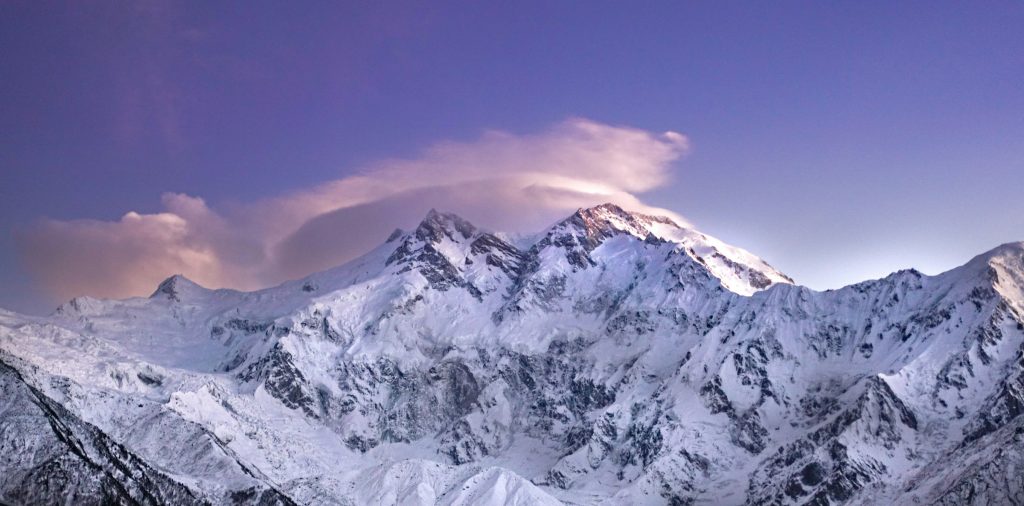
Nanga Parbat (8,126 m), the ninth-highest mountain in the world, marks the western end of the Himalaya in Pakistan's Gilgit-Baltistan region. Rising some 7,000 m above the Indus, it is one of the most massive mountains on Earth, and its early history earned it the name of the Killer Mountain long before Hermann Buhl's famous solo summit in 1953. Our expedition climbs the Diamir face by the Kinshofer route, the standard line today, first climbed in 1962.
Unlike the Baltoro peaks, Nanga Parbat has a relatively short approach. After formalities in Islamabad we drive north along the Karakoram Highway to Chilas, continue by 4x4 jeep to Halalay Bridge and the Diamir valley, then walk for three days via Sair Camp and Kutgal to Base Camp at about 4,200 m. Because the approach is short, acclimatisation happens mainly on the mountain itself, which is why our 45-day programme sets aside a generous 35-day climbing period for rotations, rest and the summit push.
The Kinshofer route is steep and sustained. Above Camp 1, the Kinshofer Wall, a band of steep rock and ice, leads to Camp 2 at around 6,000 m. Higher camps sit at around 6,800 m and 7,200 m before a long summit day through the Bazhin basin and up the final summit slopes. The face is exposed to rockfall and avalanches, so timing, conditions and careful route choice matter greatly. Our Nepali Sherpa team fixes rope, carries loads and climbs with you, while our Pakistani partner handles permits, transport, porters and Base Camp services.
Nanga Parbat is for experienced climbers only. You should have at least one 8,000 m summit, or substantial experience on technical 7,000 m peaks, and be at ease on steep rock and ice with crampons and fixed ropes. The expedition provides the support you would expect: hotels in Islamabad and Chilas, porters to Base Camp within an agreed allowance per climber, an individual tent with mattress and pillow, a heated dining tent, a cook team serving varied cuisine, power for charging and a satellite phone for emergencies. Our partner prepares the expedition permit and the documents for your online Pakistan visa, and makes the arrangements for a liaison officer if one is assigned.
Managing Director Kanchha Sherpa and our team plan every expedition around safety and patience. On Nanga Parbat that means conservative turnaround times, flexible rotations and a readiness to wait for the right conditions.
Welcome to Pakistan. Our Pakistani partner meets you at Islamabad International Airport and transfers you to your hotel, where Nima Adventure's Sherpa climbing team, flying in from Kathmandu, joins the group. The rest of the day is free to recover from the journey. In the evening we meet to check passports, insurance details and documents, and to outline the plan for the coming weeks on Nanga Parbat. Overnight at the hotel on a bed-and-breakfast, twin-sharing basis.
Today the team leader and our partner complete the expedition formalities, including the official briefing connected with the climbing permit. The rest of the day is for a thorough gear check with your Sherpa guide, last purchases in Islamabad's markets and packing equipment into porter loads. If anything is missing or doubtful, this is the best place to replace it, as choice further north is limited. Overnight at the hotel on a bed-and-breakfast basis.
A long day on the road, usually 10-12 hours, heading north on the Karakoram Highway, or over the Babusar Pass when that road is open in summer. The landscape changes from green hills to the stark, rocky gorge of the Indus, and on a clear day Nanga Parbat itself appears high above the valley. We stop along the way for meals and tea. Overnight at a hotel in Chilas, the main town of the Diamer district.
After breakfast we transfer by 4x4 jeep from Chilas to Halalay Bridge, the starting point for the Diamir valley, and continue up the valley track as far as conditions allow. From the road head we start walking, with porters carrying the expedition loads, and climb steadily through the villages and fields of the lower valley to Sair Camp. Walking time is around 4-6 hours, depending on where the vehicles stop. Overnight in tents.
The trail climbs higher into the Diamir valley, leaving the last fields behind for summer pastures and increasingly rugged alpine terrain. The Diamir face begins to dominate the view ahead, an immense wall of rock, ice and hanging glaciers that gives a clear sense of the challenge to come. The walk takes around 4-5 hours, gaining about 450 m, a sensible rate for acclimatisation. Overnight in tents at Kutgal.
A final stage of 4-5 hours brings us to Base Camp, set on the moraine below the Diamir face at around 4,200 m. Our crew sets up an individual tent for each climber, with mattress and pillow, along with the dining, kitchen, storage and toilet tents. The rest of the day is for settling in, drinking plenty and resting. In the next few days we hold a puja ceremony to ask for a safe climb before anyone sets foot on the mountain.
Over 35 days we climb the Kinshofer route in stages. Rotations establish Camp 1 (around 5,000 m), Camp 2 (around 6,000 m) above the Kinshofer Wall and Camp 3 (around 6,800 m), with our Sherpa team fixing rope and the team returning to Base Camp to recover between trips. When acclimatisation is complete and a stable forecast appears, we move up through the camps to Camp 4 (around 7,200 m) for a long summit day to 8,126 m. Spare days allow a second attempt.
We pack up Base Camp, leaving the site clean, and start down the Diamir valley. With weeks of acclimatisation behind us the descent is quick, and we pass Kutgal to reach Sair Camp in around 5-6 hours. Porters carry the return loads within the agreed allowance per climber. The thicker air, green pastures and running streams are very welcome after weeks on snow and ice. Overnight in tents.
A final walk of 3-4 hours down the valley brings us back to the road head, where jeeps take us via Halalay Bridge to Chilas. After weeks in tents, a hot shower and a proper bed are a real pleasure. We thank the porters and camp crew, who play such an important part in any expedition, and the evening is free to relax. Overnight at a hotel in Chilas on a bed-and-breakfast basis.
We drive back to Islamabad along the Karakoram Highway, or over the Babusar Pass if it is open, a journey of around 10-12 hours with stops for meals and tea. Arriving in the evening, there is time to relax at the hotel. Where required, the expedition debriefing with the authorities is completed before departure, and our partner arranges the timing. Overnight at the hotel on a bed-and-breakfast basis.
After breakfast our partner transfers you to Islamabad International Airport for your onward flight, while members of the Sherpa team return to Kathmandu. We hope you leave with lasting memories of the Diamir face and the people of northern Pakistan, and we look forward to welcoming you on another expedition, whether in the Karakoram or in the Nepal Himalaya.