
Nima Adventure Trek & Expedition P. Ltd.
Boudha-06, Kathmandu, Nepal
+977-9851114058 · info@nimaadventure.com
Boudha-06, Kathmandu, Nepal
+977-9851114058 · info@nimaadventure.com
A technical expedition to Nuptse (7,861 m) in the Everest region, through the Khumbu Icefall and Western Cwm, with Nima Adventure's experienced Sherpa climbing team.
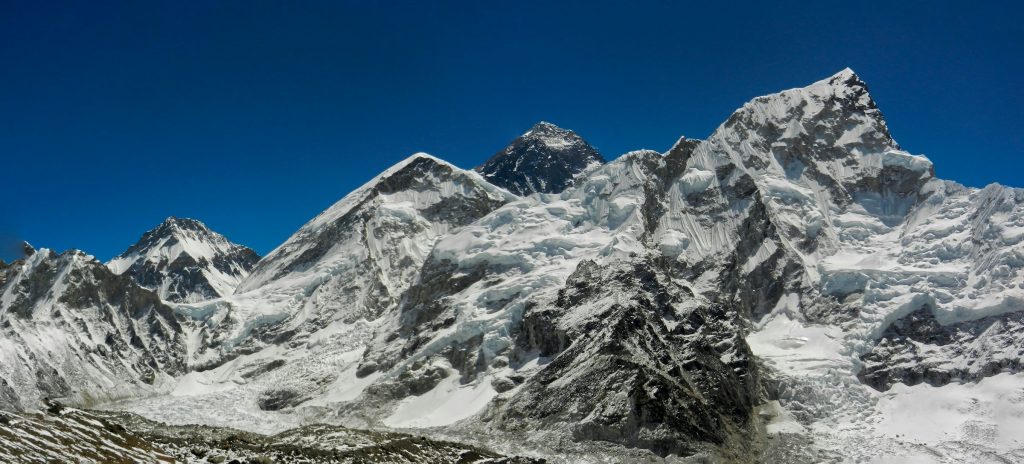
Nuptse (7,861 m) forms the western end of the great Lhotse-Nuptse wall that encloses the Western Cwm, and its jagged ridge is one of the most recognisable sights in the Everest region. From Tengboche, it hides much of Everest behind it, with only the summit of the world's highest mountain peering over the top. Despite its height and fame, Nuptse has seen remarkably few ascents since it was first climbed from the south in 1961, which makes it a rewarding objective for climbers looking for a quieter, more technical alternative to the 8,000-metre classics.
The route we use follows the Everest standard line from Base Camp through the Khumbu Icefall to Camp 1 at around 6,050 m and Camp 2 at around 6,400 m, at the head of the Western Cwm. From Camp 2, the Nuptse route crosses the Cwm to a dedicated Camp 3 at around 6,800 m and then climbs the steep north-east face on hard ice, sections of rock and, higher up, snow slopes to the summit. Summit day is shorter than on an 8,000 m peak but steeper, and it demands confident crampon and ice-axe work on sustained terrain. The icefall itself is prepared each spring by the Icefall Doctors, a specialist Sherpa team, and we keep the number of crossings to a minimum.
The expedition starts with the classic trek to Everest Base Camp: a flight to Lukla, then a gradual walk through Namche Bazaar, Tengboche, Dingboche and Lobuche, with rest days built in for acclimatisation. At Base Camp you live in a well-equipped camp with individual tents, a dining tent and a dedicated kitchen team. We arrange the climbing permit from Nepal's Department of Tourism, Sagarmatha National Park entry, the Khumbu Pasang Lhamu Rural Municipality permit and the Khumbu Icefall route arrangements, as well as the government liaison officer that Nepal assigns to expeditions.
Nuptse is for experienced alpinists who have climbed at least one technical 6,000-7,000 m peak, such as Ama Dablam, and who move confidently on steep ice. Previous experience of the Khumbu Icefall or of an 8,000 m peak is a strong advantage. Under the direction of Managing Director Kanchha Sherpa, a career Himalayan guide, our Sherpa team plans a conservative schedule with careful rotations and spare days for weather.
Welcome to Nepal. A Nima Adventure representative meets you at Tribhuvan International Airport and transfers you to your hotel in Kathmandu. After checking in, the rest of the day is free to recover from your journey or stroll through the lanes of Thamel. In the evening we meet at the hotel or our office in Boudha to check documents and insurance details and to introduce the plan for the Nuptse expedition. Overnight at the hotel on a bed-and-breakfast basis.
Today we complete the formalities for the Nuptse climbing permit, including the official expedition briefing at Nepal's Department of Tourism, where you meet the government liaison officer assigned to the team. Your Sherpa guide then runs through your equipment piece by piece. Kathmandu has good mountaineering shops, so anything missing can be bought or hired here. In the afternoon there is time to visit Boudhanath Stupa, close to our office. Overnight at the hotel.
An early flight of about 35 minutes takes us to Lukla, the gateway to the Khumbu. In busy seasons, flights may leave from Ramechhap, a drive of around 4-5 hours from Kathmandu. After meeting the porters, we walk down through Chaurikharka and along the Dudh Koshi to Phakding, an easy 3-4 hours that helps the body begin to adjust. Overnight in a teahouse.
We follow the Dudh Koshi upstream, crossing it several times on suspension bridges, and enter Sagarmatha National Park at Monjo. After Jorsale, a long, steady climb leads up to Namche Bazaar, with the first glimpse of Everest on a clear day. Walking time is around 5-6 hours. Namche is the Sherpa capital of the Khumbu, with shops, bakeries and a weekly market. Overnight in a teahouse.
A rest day at Namche is essential for acclimatisation. In the morning we hike up to the Everest View Hotel area or to the villages of Khumjung and Khunde, gaining height for views of Ama Dablam, Everest, Lhotse and Nuptse before returning to sleep lower. In the afternoon you can visit the Sherpa museum or the national park visitor centre. Overnight in a teahouse.
A beautiful trail contours high above the Dudh Koshi with Ama Dablam ahead, then drops to the river at Phunki Tenga before a steady climb through rhododendron forest to Tengboche. The monastery here is the largest in the Khumbu, and from its grounds you can see the long ridge of Nuptse with Everest peering over the top. About 5-6 hours of walking. Overnight in a teahouse.
We descend through forest to Deboche, cross the Imja Khola and climb past Pangboche, one of the oldest villages in the Khumbu. Above the tree line the valley opens out, and the huge south face of Lhotse and Nuptse rises ahead. Dingboche sits among stone-walled fields at about 4,410 m. Walking time is around 5-6 hours. Overnight in a teahouse.
Another rest day helps the body adjust before going higher. We hike up the ridge of Nangkartshang above the village, gaining several hundred metres, for views of Makalu, Lhotse, Island Peak and Ama Dablam, then return to Dingboche for lunch. The afternoon is free to rest, read and drink plenty of fluids. Your Sherpa guide checks how everyone is feeling. Overnight in a teahouse.
The trail climbs gradually above Pheriche and Dughla, then steeply up to the memorials at Thukla Pass, where climbers lost on Everest and other Khumbu peaks are remembered. Beyond, the path follows the edge of the Khumbu Glacier moraine to Lobuche. Allow around 5-6 hours. Pumori and Lobuche East dominate the views, and the air is noticeably thinner. Overnight in a teahouse.
We follow the moraine of the Khumbu Glacier to Gorak Shep (5,164 m) for lunch, then continue on to Everest Base Camp, spread out on the glacier beneath the Khumbu Icefall. The walk takes around 6-7 hours. Our crew has Base Camp ready: individual tents, a dining tent and a kitchen team, and this will be home for the coming weeks. Rest and drink plenty. Overnight at Base Camp.
We begin with a puja, the Buddhist ceremony Sherpa climbers perform to ask for safe passage before climbing. The following day is for rest and a skills refresher: your Sherpa guide reviews fixed-rope technique, ascender and descender use, crampon work and glacier travel. Meanwhile our climbing team scouts the lower route on Nuptse and starts carrying ropes, tents and fuel towards Camp 1.
Rotations begin with the Khumbu Icefall, climbed in the cold hours before dawn on the route maintained by the Icefall Doctors. We establish Camp 1 (around 6,050 m) at the edge of the Western Cwm and Camp 2 (around 6,400 m) at its head, returning to Base Camp between rotations. Later, our Sherpa team crosses the Cwm to set Camp 3 (around 6,800 m) beneath the north-east face and fixes rope on the lower part of the Nuptse route.
After a rest at Base Camp, we wait for a settled forecast with light winds. The summit push takes around four to five days: through the icefall to Camp 2, across the Cwm to Camp 3, then an early start up the steep north-east face on hard ice, rock steps and snow slopes to the summit at 7,861 m. Turnaround times are agreed in advance. Spare days allow a second attempt if the weather turns.
We pack up Base Camp, leaving the site clean and carrying all waste down, then walk back past Gorak Shep and Lobuche and over Thukla to Pheriche. The descent takes around 6-7 hours, and with every step the air feels richer. Pheriche is home to a Himalayan Rescue Association aid post, open in the main seasons. In the evening we celebrate the climb with the team. Overnight in a teahouse.
We continue down the valley past Pangboche and Tengboche, re-entering the rhododendron forest, before the final climb and contour back to Namche Bazaar. It is a long day of around 6-7 hours, but the trail is familiar and mostly downhill. Namche's cafes and bakeries are a good reward. Overnight in a teahouse.
Our last day on the trail follows the Dudh Koshi down through Monjo and Phakding, before a final climb up to Lukla. Allow around 6-7 hours. In the evening we share a final meal with the porters and crew who supported the expedition, and thank them for their hard work. Overnight in a teahouse in Lukla.
We take an early morning flight back to Kathmandu, or to Ramechhap followed by a drive, depending on the season. Mountain flights depend on clear weather and can be delayed, which is why the itinerary includes a spare day. On arrival you are transferred to your hotel, and the rest of the day is free for a long shower and a well-earned rest. Overnight at the hotel.
This day is kept in reserve for delays caused by weather or transport. If it is not needed, we complete the expedition debriefing and you are free to explore Kathmandu: the old royal squares of Kathmandu and Patan, Swayambhunath on its hilltop or the shops of Thamel. It is also a good moment to celebrate the Nuptse expedition with the team before heading home. Overnight at the hotel on a bed-and-breakfast basis.
After breakfast, we transfer you to Tribhuvan International Airport in good time for your onward flight. We hope you leave with strong memories of Nuptse and of the people who climbed it with you, and we look forward to welcoming you back to the Himalaya, whether for another expedition, a peak climb or a relaxed trek.