
Nima Adventure Trek & Expedition P. Ltd.
Boudha-06, Kathmandu, Nepal
+977-9851114058 · info@nimaadventure.com
Boudha-06, Kathmandu, Nepal
+977-9851114058 · info@nimaadventure.com
Climb Putha Hiunchuli (7,246 m), a non-technical 7,000-metre peak in remote Dolpo, on a fully supported 33-day expedition through some of Nepal's least visited valleys.
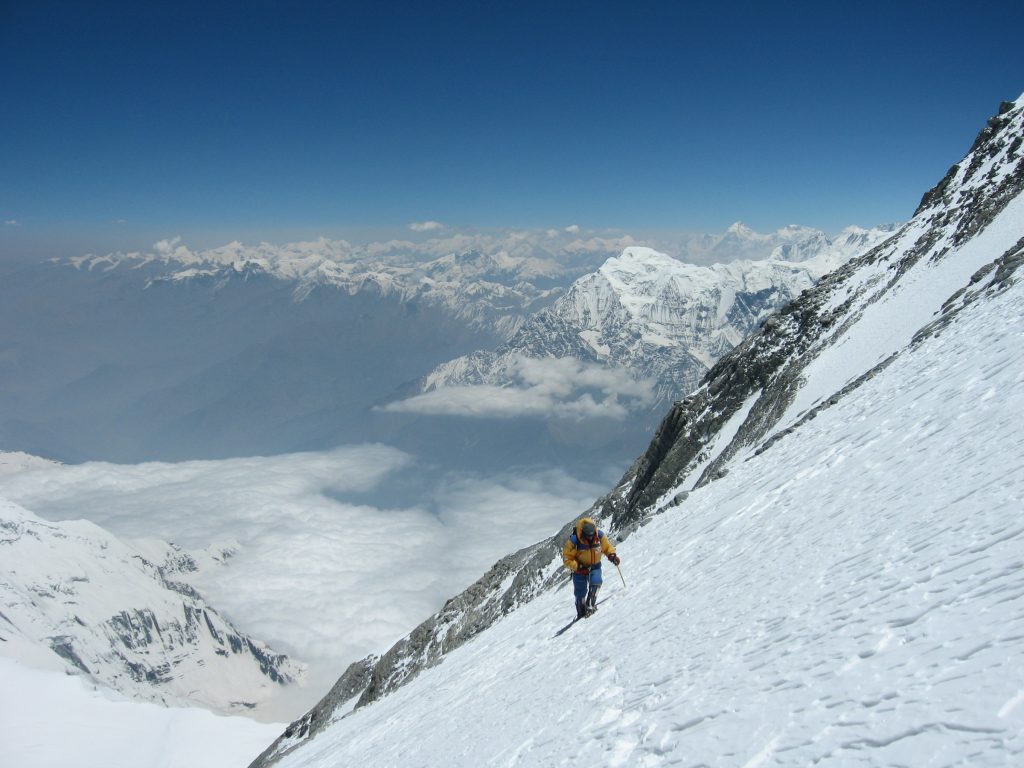
Putha Hiunchuli (7,246 m), also known as Dhaulagiri VII, is the westernmost high summit of the Dhaulagiri Himal, rising above the remote valleys of Dolpo in western Nepal. It was first climbed in 1954 by Jimmy Roberts, the British officer who later pioneered trekking in Nepal, and it has since become a favourite first 7,000-metre peak. The standard route follows broad snow slopes and glaciers on the north-east side of the mountain at fairly consistent angles, with no long technical sections, which makes it an ideal place to learn how your body performs at real altitude.
What sets Putha Hiunchuli apart is the journey. We fly from Kathmandu to Nepalgunj on the southern plains, then on to the mountain airstrip at Juphal in Dolpo. From there the trek follows the Thuli Bheri river through Dunai and the old hilltop village of Tarakot, then climbs through the quiet valleys of Musi Khola to Kagkot. After a rest day for acclimatisation, we cross two high passes to a camp at around 4,500 m and reach base camp at around 4,900 m. Few expeditions travel this way, and the villages, culture and wide open landscapes feel a world away from the busier Khumbu.
On the mountain, our Sherpa team establishes Camp 1 at around 5,500 m and Camp 2 at around 6,300 m, adding a higher camp when snow conditions or the team's pace require it. A climbing period of 16 days gives time for acclimatisation rotations and a summit push in a stable weather window. Summit day is long rather than steep, crossing wide snow slopes and finishing on the summit ridge with views of Dhaulagiri, Churen Himal and the mountains of Dolpo. Base camp is run by our own cook and kitchen team, with individual sleeping tents, solar power, satellite phone communication and regular weather forecasts.
Putha Hiunchuli suits climbers who have reached 6,000 m on a trekking peak, such as Mera Peak, Island Peak or one of the Chulus, and want to step up to 7,000 m without the technical demands of Ama Dablam or Pumori. You need good crampon and fixed-rope skills, solid fitness and patience for a remote expedition where mountain flights depend on the weather. Nima Adventure handles all logistics, permits and staffing from our office in Boudha, Kathmandu, under the direction of Managing Director Kanchha Sherpa, whose team has guided Malaysian climbers on Everest, K2 and Manaslu.
Our team meets you at Tribhuvan International Airport and transfers you to your hotel. After you have rested, we hold a welcome meeting to introduce the expedition team, check passports and insurance details and outline the programme. The rest of the day is free. Boudhanath Stupa, close to our office in Boudha, is a peaceful place for an evening walk among pilgrims turning prayer wheels, and a gentle way to begin your journey.
We finalise your Putha Hiunchuli climbing permit and the Dolpo trekking permits, and attend the expedition briefing with the relevant authorities. Your climbing leader checks your personal gear so that anything missing can be bought or hired in Thamel before we leave. Expedition food, fuel and group equipment are packed and weighed for the flights west. In the evening we talk through the acclimatisation plan, communication and safety procedures.
A flight of about an hour takes us west to Nepalgunj, a busy town on the Terai plains close to the Indian border. The heat and bustle make a striking contrast with the mountains ahead. We stay overnight in a hotel, repack loads for the small aircraft and prepare for the early morning flight to Juphal, which operates only in good visibility. Expect warm temperatures, especially in spring.
A short and spectacular flight over forested hills, with views of the high Himalaya, lands at the small airstrip of Juphal. After meeting our porters and mule team, we walk down through terraced fields and pine forest to the Thuli Bheri river and follow it to Dunai, the district headquarters of Dolpa. The walk takes 2-3 hours, a gentle start to the trek. Overnight in a simple lodge or camp.
We follow the Thuli Bheri upstream through a narrow gorge, passing small villages, water-driven mills and fields of barley and buckwheat. The trail is mostly gentle, with a final climb to Tarakot, an old hilltop village overlooking the river where the valley begins to widen. Expect 5-6 hours of walking. Overnight in a simple lodge or our tented camp, with meals prepared by our cook team.
Leaving the main valley, we follow a quieter trail higher into wilder country, through forest and past seasonal herders' settlements, to a riverside camp at Musi Khola. The scenery becomes more dramatic with each hour, and you are unlikely to meet other trekkers. Walking time is around 5-6 hours, with some steep sections. From here onwards we stay in tents, with all meals prepared by our camp crew.
A steady climb leads to Kagkot, a traditional village set on a high shelf with wide views of the surrounding ridges. Life here follows the rhythm of the seasons, with villagers working small terraced fields and taking livestock to high pastures in summer. We camp near the village. Walking time is about 5 hours, and the gain in height is a useful step in our acclimatisation.
A rest day to let the body adapt before the high passes. We take a short hike above the village to gain height and return to camp to sleep, following the climb high, sleep low principle. There is also time to walk through Kagkot, wash clothes, check equipment and practise rope techniques with your climbing guide. A relaxed day that pays off higher up.
This is a long and demanding day, crossing two high passes on the way to camp at Panjing, also written Pangzi, a high pasture at around 4,500 m. The route climbs above the tree line into open, rugged country, with the peaks of the Dhaulagiri Himal coming into view. Walk at a steady pace, drink plenty and keep warm layers handy. Expect 6-8 hours of walking.
A shorter day takes us up the valley to base camp at around 4,900 m, beneath the broad snow slopes of Putha Hiunchuli. Our kitchen and Sherpa team set up the dining tent, kitchen and an individual sleeping tent for each member. The afternoon is for resting, drinking plenty of fluids and taking in the remarkable silence of this remote corner of Nepal. Walking time is 4-5 hours.
After a puja ceremony, the Sherpa team fixes ropes on steeper sections and stocks Camp 1 at around 5,500 m and Camp 2 at around 6,300 m, with a higher camp added when conditions require. Members complete acclimatisation rotations, returning to base camp to recover. With a good forecast, we make the summit push: a long day over broad snow slopes and the summit ridge to the top, then descent to a lower camp. Spare days cover bad weather.
After dismantling base camp and packing out all rubbish, we retrace our route over the two high passes and descend to Kagkot. It is a long day of 7-8 hours, but losing more than 1,600 m of altitude brings warmer nights, better sleep and a returning appetite. We camp near the village, and the evening is a good moment to celebrate the climb with the whole crew.
We descend past Musi Khola and through forest back to the main valley at Tarakot. The trail is now familiar, which makes for an easier day despite its length of around 6-7 hours. With plenty of oxygen in the air, you can enjoy the villages, fields and river scenery that may have passed in a blur on the way in. Overnight in camp or a simple lodge.
An easy walk down the Thuli Bheri gorge brings us back to Dunai, with its small shops, lodges and government offices. Walking time is 5-6 hours. After weeks of camping, a hot wash and a cold drink in Dunai feel like real luxuries. In the evening we celebrate with the porters and camp staff who have supported the expedition from the very first day.
A short final walk of 2-3 hours climbs back up through terraced fields and pine forest to Juphal. The afternoon is free to rest and repack for the flights. Juphal flights operate only in clear conditions, so we reconfirm departure times and keep luggage ready for an early start. Overnight in a simple lodge near the airstrip.
An early morning flight takes us back to Nepalgunj, where we connect with a flight to Kathmandu. On arrival, we transfer you to your hotel for a long shower and a comfortable bed. If weather delays the Juphal flight, the reserve day that follows keeps your international departure on track. The rest of the day is free to relax.
This day is held in reserve for possible flight delays from Dolpo. If it is not needed, you can explore Boudhanath Stupa, Swayambhunath, Pashupatinath or the old city of Patan, or simply rest at the hotel. In the evening we host a farewell dinner to celebrate the expedition and talk through your next Himalayan objectives over a well-earned meal.
Our team transfers you to Tribhuvan International Airport around three hours before your international flight. If time allows beforehand, enjoy a last walk around Boudha or Thamel for souvenirs. Thank you for climbing with Nima Adventure; we hope to welcome you back to the Himalaya for your next expedition, whether an 8,000-metre peak or a quiet trek.