Everest Gokyo Ri Trek



Trip Overview
The Everest Gokyo Ri Trek is a rewarding alternative to the main Everest Base Camp trail, following the Dudh Koshi valley north to the Gokyo Lakes and the viewpoint of Gokyo Ri (5,357 m). From the top of Gokyo Ri, Everest, Lhotse, Nuptse, Makalu, Cho Oyu and Gyachung Kang rise above the vast Ngozumpa Glacier, one of the longest glaciers in the Himalaya, while the turquoise waters of the Gokyo Lakes lie directly below. It is one of the great panoramas of the Khumbu, reached on a quieter trail than the route to base camp.
The 14-day trek begins with the flight to Lukla and the walk to Namche Bazaar, where you spend an acclimatisation day with a hike to the Everest View Hotel and the traditional village of Khumjung. At Sanasa you leave the base camp trail and climb to the ridge-top viewpoint of Mong La before descending to the river at Phortse Thanga and continuing up the valley through Dole and Machhermo. These are smaller, quieter settlements than those on the main trail, surrounded by summer yak pastures, with Cho Oyu ahead and Thamserku and Kangtega behind you.
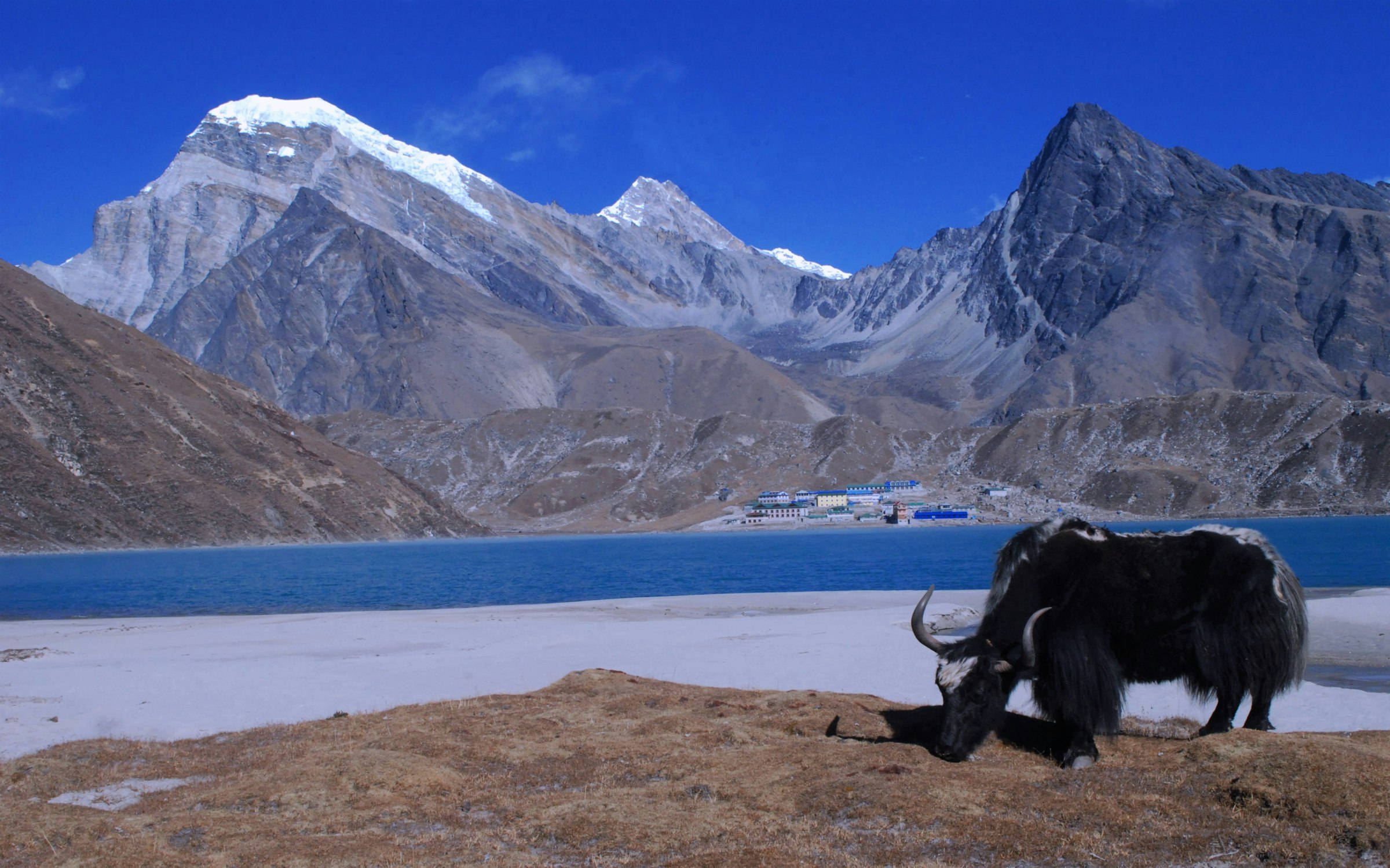
A second acclimatisation day at Machhermo prepares you for the higher ground. The trail then climbs alongside the moraine of the Ngozumpa Glacier, past the first and second lakes, to Gokyo village on the shore of the third lake, Dudh Pokhari. The Gokyo Lakes form a high-altitude wetland protected under the Ramsar Convention and are considered sacred by both Hindus and Buddhists. The next morning you climb Gokyo Ri before sunrise, and later you can walk further up the valley to the fourth and fifth lakes and Scoundrel’s Viewpoint, where Everest and Cho Oyu appear across the glacier. The return follows the same valley down to Namche and Lukla, giving you a second chance to enjoy the views.
Who is this trip for?
This trek suits fit walkers without technical experience who are happy with 4-6 hours a day on hilly trails, and it is a good choice if you prefer quieter paths and lakeside scenery to the busier base camp route. Nima Adventure, led by Managing Director Kanchha Sherpa, plans the itinerary around safe acclimatisation, and your government-licensed guide and porters look after the details so that you can concentrate on the mountains.
Trip highlights
- Sunrise panorama from Gokyo Ri (5,357 m)
- The turquoise Gokyo Lakes, a Ramsar-listed wetland
- Views of Everest, Lhotse, Makalu and Cho Oyu
- The Ngozumpa Glacier, one of the longest in the Himalaya
- Quieter trails via Mong La, Dole and Machhermo
- Acclimatisation days in Namche Bazaar and Machhermo
- Optional walk to the fifth lake and Scoundrel's Viewpoint
Itinerary
On arrival at Tribhuvan International Airport, a Nima Adventure representative meets you and transfers you to your hotel. After settling in, you meet your guide for a briefing on the Gokyo trek, a check of your clothing and equipment, and a chance to ask any questions. If anything is missing, the trekking shops of Thamel are close at hand. The rest of the day is free. Overnight in Kathmandu.
Depending on the season, you fly to Lukla directly from Kathmandu or drive 4-5 hours to Manthali Airport in Ramechhap for the flight. The approach to Lukla, with terraced hills giving way to snow peaks, is a dramatic start. After meeting your porters, an easy, mostly downhill walk through Chaurikharka and small villages brings you to Phakding beside the Dudh Koshi. Walking time 3-4 hours. Overnight in Phakding.
The trail heads upstream along the Dudh Koshi, crossing the river on several suspension bridges, with the peak of Thamserku rising to the east. At Monjo you enter Sagarmatha National Park. After Jorsale, the high Hillary Suspension Bridge marks the start of the long climb to Namche Bazaar, the horseshoe-shaped market town that is the gateway to the high Khumbu. Walking time 6-7 hours. Overnight in Namche.
Today you acclimatise by hiking high and returning to sleep in Namche. A morning walk of about 1.5 hours leads to the Everest View Hotel (3,880 m), with views of Everest, Lhotse and Ama Dablam, and continues to Khumjung, a traditional Sherpa village whose monastery keeps a famous yeti scalp. You return to Namche along the hillside path in the afternoon. Walking time 4-5 hours. Overnight in Namche.
From Namche the trail contours to Kyangjuma and Sanasa, where you leave the Everest Base Camp route and climb to the ridge-top stupa of Mong La (3,975 m), a superb viewpoint for Ama Dablam, Thamserku and Kangtega. The path then drops steeply to the river at Phortse Thanga before climbing through rhododendron and birch forest, where musk deer and Himalayan monal are often seen, to Dole. Walking time 5-6 hours. Overnight in Dole.
Above Dole the trees thin out, and the trail climbs steadily along the side of the valley through the summer settlements of Lhabarma and Luza, with Cho Oyu appearing at the head of the valley. The walk is relatively short, which helps acclimatisation, and you reach Machhermo, a sheltered settlement in a side valley, in time for lunch and a relaxed afternoon. Walking time about 4 hours. Overnight in Machhermo.
A rest day at this altitude prepares you for Gokyo and Gokyo Ri. In the morning you hike up the ridge above Machhermo, gaining a few hundred metres for views of Cho Oyu, Kangtega, Thamserku and Cholatse, before returning to the village for lunch. The afternoon is free to rest, read and drink plenty of fluids, and your guide uses the day to check that everyone is acclimatising well. Overnight in Machhermo.
The trail climbs to a ridge with views back down the valley, then descends to the riverside at Phangka before climbing alongside the moraine of the Ngozumpa Glacier. Soon you reach the first of the Gokyo Lakes, followed by the second, and finally Gokyo village on the shore of the third lake, Dudh Pokhari, its turquoise water framed by peaks. Walking time 4-5 hours. Overnight in Gokyo.
Leaving before dawn, you climb the steep trail up Gokyo Ri in about 2 hours. From the summit, sunrise lights up Everest, Lhotse, Makalu, Cho Oyu and Gyachung Kang, with the Ngozumpa Glacier and Gokyo Lakes spread out below. After breakfast you can rest or, if you have the energy, walk further up the valley to the fourth and fifth lakes and Scoundrel's Viewpoint, a round trip of 5-6 hours. Overnight in Gokyo.
After a final look at the lakes, you descend past the second and first lakes and along the Ngozumpa moraine, then back through Machhermo and Luza to Dole. The descent is gentle, and with more oxygen in the air the walking feels easy, giving you time to enjoy views you may have missed on the way up. Walking time 5-6 hours. Overnight in Dole.
The trail descends through forest to Phortse Thanga, then climbs back up to Mong La for a final view of Ama Dablam and Everest before the traverse to Namche Bazaar. Arriving in the afternoon gives you time to relax in a bakery, browse the shops for souvenirs or simply enjoy the bustle of the Sherpa capital. Walking time 5-6 hours. Overnight in Namche.
Descend the long Namche hill to the Hillary Suspension Bridge, then retrace your route along the Dudh Koshi through Jorsale, Monjo and Phakding. A gentle final climb brings you back to Lukla. Spend the evening celebrating with your guide and porters, the team who have looked after you throughout the trek. Walking time 6-7 hours. Overnight in Lukla.
Flights leave Lukla early in the morning, when the weather is usually calmest. You fly to Kathmandu directly or to Ramechhap, followed by the drive back to the capital. Delays are possible if the weather closes in. The rest of the day is free to rest, shop or visit one of Kathmandu's UNESCO-listed sites, such as Boudhanath Stupa or Pashupatinath. Overnight in Kathmandu.
Your Gokyo trek comes to an end today. Depending on your flight time, you may have a few hours for a last walk around Thamel or a coffee in one of its garden cafes. A Nima Adventure representative will transfer you to Tribhuvan International Airport in good time for your flight home. If you would like to stay longer in Nepal, we can help arrange tours, safaris or another trek.
What’s included
Cost Includes
15 items- Airport arrival and departure transfers by private vehicle
- Hotel accommodation in Kathmandu on a bed and breakfast basis, as per the itinerary
- Flights between Kathmandu (or Ramechhap) and Lukla, with road transfers to Ramechhap when flights operate from there
- Teahouse accommodation throughout the trek
- Breakfast, lunch and dinner during the trek
- Tea, coffee and hot water during the trek
- Government-licensed, English-speaking trekking guide
- Porter service on a sharing basis
- Wages, meals, accommodation, equipment and insurance for your guide and porters
- Sagarmatha National Park entry permit
- Khumbu Pasang Lhamu Rural Municipality permit
- Nima Adventure duffel bag for the trek
- First aid kit carried by your guide
- Welcome or farewell dinner in Kathmandu
- All government taxes and agency service charges
Cost Excludes
11 items- International flights to and from Nepal
- Nepal visa (available on arrival at Kathmandu airport for most nationalities)
- Travel insurance covering trekking to 5,500 m or above, including helicopter evacuation (mandatory)
- Lunch and dinner in Kathmandu, apart from the welcome or farewell dinner
- Extra hotel nights in Kathmandu due to early arrival, late departure or early return from the trek
- Additional costs caused by flight delays, cancellations or bad weather
- Personal expenses such as drinks, snacks, hot showers, battery charging, Wi-Fi and laundry
- Personal trekking clothing and equipment
- Emergency evacuation and medical costs (covered by your insurance)
- Tips for your guide and porters
- Anything not listed under Includes
Equipment Checklist
Foot Wear
3- Normal Socks 3-4Pairs
- Trekking Shoes 1 Pair
- Slippers
Hands
2- Thin Fleece Gloves 1 Pair
- Wind Stopper Fleece Gloves
Upper Body
6- Light Weight Top / Thermo Coat
- Buff
- Fleece Jacket 1
- Gore Tex Jacket 1
- Down Jacket 1
- Cotton T-Shirt 2-3
Lower Body
4- Mid Weight Long Under Pants
- Under Wear 4-5 Pairs
- Gore Tex Pant. 1
- Water Proof Pant1
Head
4- Sun Cap
- Balaclava
- Fleece Hat
- Neck Gaiter 2-3
Sleeping Bags
1- Sleeping Bag rated to -20°C For base camp
Bag Packs
2- Rucksacks 45-55L
- Duffle Bag 90 L 1 Piece
Sun stuffs
4- Sunscreen Minimum SPF 50
- Lip balm with SPF 30
- Sunglasses UV protection
- Toiletries.
Medicines
7- Brufen / Ibuprofens
- Antibiotic
- Diamox
- Paracetamol
- Handy Plaster
- Crack Bandage
- Tincture Iodine
Miscellaneous
2- Walking Stick
- Umbrella / Rain Coat
Head
3- Sun hat or scarf
- Winter hat or insulating hat or Wide-brimmed hat
- Headlight with extra batteries
Face
6- Sunscreen
- Sunglass with UV protection
- Face/body wipes
- Hands
- Light weight gloves
- Heavy weight winter gloves
Body
10- Hiking shirts
- Long sleeved shirt
- Hooded rain jacket
- Fleece jacket
- Light weight cotton pants
- T- Shirt bring Light weight wool
- Polypropylene underwear
- Down jacket available in rent in Kathmandu
- Sweater
- Water proof jacket and pants
Note: When you are up in the mountains in Nepal, we would suggest you to be ready for anything. Weather forecasts for Lukla are never correct and different sources will give you different information. If it is a really bad day in terms of weather, the airlines will themselves cancel the flight and you might have to wait till the weather clears. Yes, flying in high altitude is never easy, even on a clear sunny day, the plane might face turbulence because of the wind blowing from the mountains. But overall the flight to Lukla is very exciting and it’s an experience that you will never forget
Route Map
Frequently asked questions
Both treks start in Lukla and share the trail to Namche Bazaar, then divide. The Gokyo route is quieter, with smaller settlements, turquoise lakes and a summit view that takes in four of the six highest mountains on Earth. The Base Camp trek takes you closer to Everest itself. The highest point on this trek, Gokyo Ri at 5,357 m, is slightly lower than Kala Patthar.
This is a moderate trek with no technical sections, but you walk 4-6 hours on most days on hilly, uneven trails, and the climb up Gokyo Ri is steep. If you are in good health and train for a couple of months with regular hill walks or stair climbing, you should enjoy it. Previous multi-day hiking experience is useful but not essential.
The itinerary includes acclimatisation days in Namche Bazaar and Machhermo, and daily height gains are kept moderate. Your guide checks on everyone each day and watches for symptoms of altitude sickness. If symptoms persist, descent is the most effective treatment and your guide will arrange it. Serious cases can be evacuated by helicopter, which is why insurance with helicopter cover is mandatory.
You need the Sagarmatha National Park entry permit and the Khumbu Pasang Lhamu Rural Municipality permit. Both cover the Gokyo valley, and Nima Adventure arranges them before the trek begins. Carry your passport with you, as permits are checked at Monjo and at other points along the trail. Most nationalities can obtain a Nepal visa on arrival in Kathmandu.
March to May and late September to November are the best periods, with stable weather and clear mountain views. In spring, the lower forests are bright with rhododendrons; in autumn, the air is particularly clear. Winter is cold and the lakes may freeze over, but skies are often clear. The summer monsoon brings cloud and rain and frequently disrupts Lukla flights.
Gokyo has several well-run lodges on the lakeshore, with twin rooms, warm dining rooms and good menus for the altitude. Rooms are simple and unheated, so a warm sleeping bag is important. Most lodges offer hot showers, battery charging and Wi-Fi for an extra charge, and bathrooms are usually shared at this altitude.
Trip Reviews
Submit your review | |
Plan Everest Gokyo Ri Trek with our team
Tell us your dates and group size and we will reply within 24 hours with availability, a tailored itinerary and a group price.
- Reply within 24 hours
- No booking fees
- Free itinerary tailoring